Why Study Art?

Updated: 2 hours ago
I met Socrates in his final moments on the wall of the Met. The 71-year-old man sitting before me was a spectacle indeed: 30 days earlier an Athenian jury had decided, 280 to 221, to convict the old philosophically-bearded man, the thinker that had so distinctively and defiantly defined Western thought and brought many an aspiring sage to Athens’s marble doors.
David’s masterful technique intrigued me. I became curious as to how art could animate a story, how it could elucidate history in a way words could not—how an inanimate chemical concoction could lead the viewer to feel something new, something different. As I stared I noticed how David depicted the tension that palpably gripped Socrates’s final stand using contrasting shapes. Socrates sits stoically straight compared to the rounder forms of those grieving beside him, such as the man clad in red holding the deadly poison. Intrigued by my new find, I decided to study his original drafts from 1782 and 1786. Hidden in his inky preparatory renditions were subtle differences from the painting I analyzed on the wall: the barrel vault archway had replaced a wall with a single shadow; the towering lamp in the background had substituted a shelf initially behind Socrates’s finger. But to me the most interesting, most telling difference was the position of the philosopher’s hand. The sketch depicts a pointed hand just behind the cup of poison instead of the final position that hovered above.
In addition to his technique I became fascinated with how David injected his political ideas into the painting. He portrays Socrates as this intractable man, willing to die for his own beliefs in an unmitigated rejection of a ruling authority. We as the viewer can safely assume this resistance was a symbol of reverence for the revolutionaries of France. With the historical context of the painting in mind, I realized that the choice to position Socrates’s hand above the poison rather than behind it represented the transcendence of his ideas beyond the here and now to some higher plane; with a couple brushstrokes David tells the viewer that Socrates would inspire posterity for millenia. The gesture, in my view, also holds more profound philosophical symbolism. Socrates’s student, Plato, who David clothes in a sorrowful bluish gray, would go on to transform his mentor’s search for objective definitions of abstract concepts—beauty, justice, courage, etc.—into his theory of forms, in which the purest things dominated. Socrates’s hand over the cup represents not only his steadfast belief of dominance of virtue over ignorance, of good over what he deemed as evil, but also the seed for what his mentee would later think about and develop further.
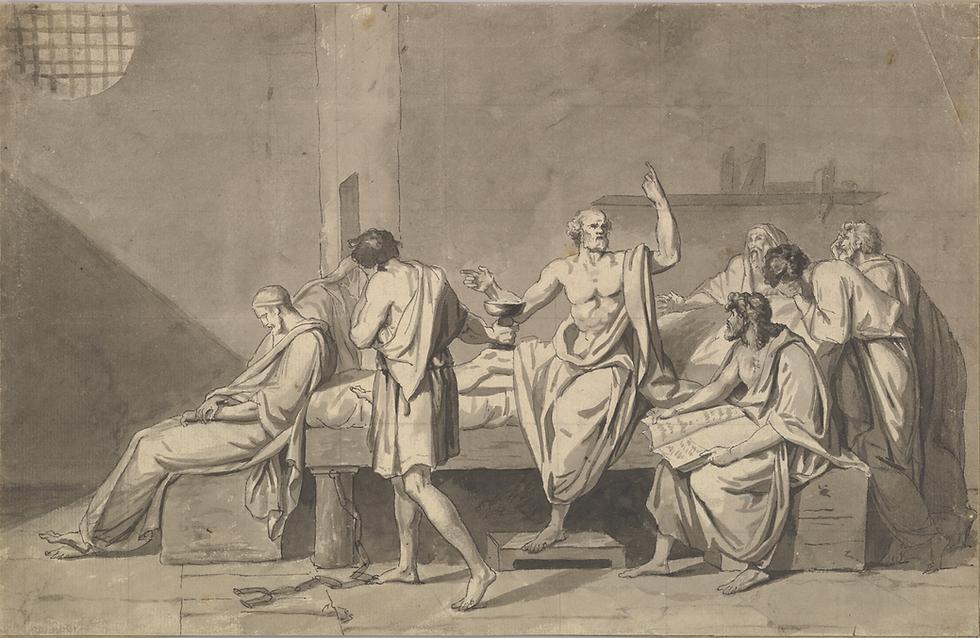
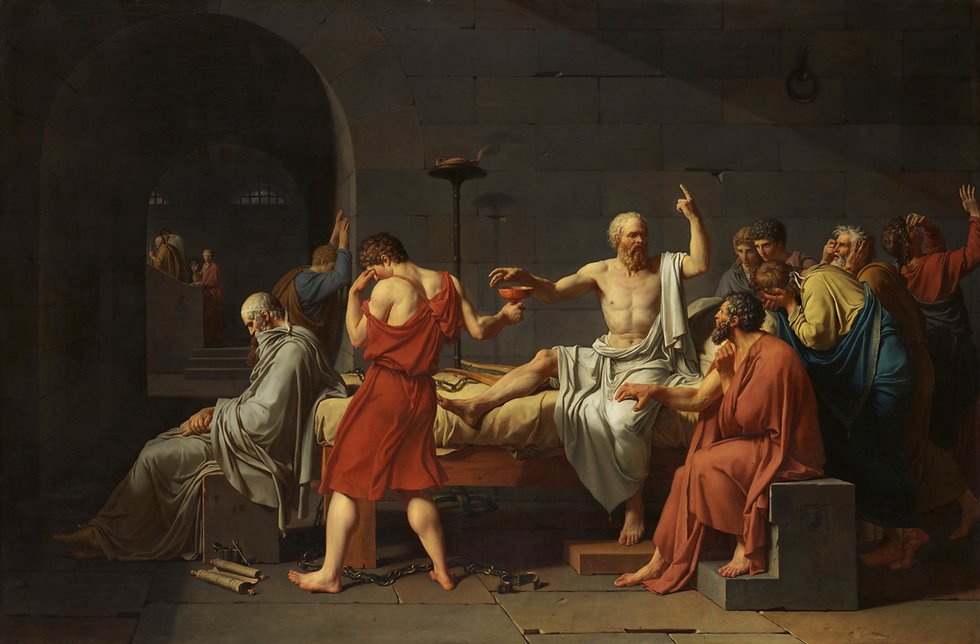
This kind of detail modifies the painting’s message, but only if the viewer is keen enough to notice. Each master, each artwork, has something new to offer in their individual choices of medium, perspective, and subject. Sandro Botticelli of the Renaissance chose to remove the shadow and depth of his figures in the Birth of Venus to take away the sense of reality with his mythological depictions. Claude Monet chose to paint 8 grand panels of continuous abstract Water Lilies perhaps as a parallel to the millions of soldiers’ lives lost in the Great War. With the hundreds of decisions these artists make such as those of David, I recognize that art is an investigation of the human soul, a journey to convey subject and one's perspective towards it. So here my own journey begins. The great macrocosm of art lies all around us, and I hope you, dear reader, will follow along to actively explore it, paintbrush in hand or not :)
Comments